Sunday, November 6, 2011

Getting Lost in Japan – ちょっと迷っています!

I should preface this by warning everyone that I am a huge nerd. I have World of Warcraft T-Shirts and spend lots of time in Japanese toy-stores looking at the pokemon toys. So recently, when I found a group of “Dungeons and Dragons” players in my area I was thrilled. However, I need dice to play D&D. So, at the recommendation of my co-worker (and soon to be brother in arms), Mike, I went to a gaming store in the nearby Sanjo district where I could obtain some dice.

So on Saturday after my Japanese tutoring lesson I set out cheerfully, without my contact lenses or my umbrella (the first an accident, the second hubris), to have an adventure...and an adventure I found! As soon as I left the subway station in Sanjo I saw that it was raining. Being an Oregonian and seeing that it was only a drizzle, I thought I would be just fine with my hooded jacket, so I set out. Unfortunately, the map Mike had drawn pictured the river running right through the subway station, when in reality the station was only on one side. Did I cross the river or continue away from it? I could have asked a passer-by, but not minding a bit of a wander I set out into the rain instead. 

 (I seem to have run out of city...)

(A persimmon tree hanging over a stream between two houses.  I also took a picture of the street just behind me, to give you an idea of what most of the walk looked like.)


About an hour later I ran out of road and surmised that, perhaps, I had gone the wrong direction. By then my clothes were getting soggy and I was very hungry. I retreated back the way I had come, and stopped to refuel and regroup at the McDonald's I had passed on my way out. In addition to a dry place to sit and eat fattening foods, McDonald's was also selling pokemon calendar's for 350 yen. I bought one.

(I will never grow up. Never.)

Refreshed, I set out yet again. This time I walked the other direction, and came upon the shopping district that Mike had told me about. It was pretty crazy! The sidewalks were jammed full of people and there were neon lights everywhere. Once again I went too far in the wrong direction and had to double back. Finally, after asking some street vendors where I could find the place, I headed up some sketchy looking stairs into the fourth floor of a building...and emerged into a brightly lit store full of Japanese gamers playing trading card games. 

The store “Yellow Submarine” sold mostly trading cards, but it also had dice and Dungeons and Dragons books (in Japanese). I explained that I wanted to buy dice, and after a long session of pointing and sharing confused looks I had a good selection...but when I got up to the cash register I found out that I had chosen the expensive dice, which were about 300 yen a piece. Usually I try to live frugally, but after tromping around in the rain for four hours (I'm not kidding) to find this place, I was going to buy the damn things. 2700 yen (about $30, again, not kidding) was a small price to pay to achieve my objective so I could pull my sorry butt home. On my way down the stairs, I noticed that my legs were cramping up, which gives you an idea of how much walking I had done.
I have drawn a small diagram to illustrate my route:


I think it was a worthwhile experience, even if I did get horribly lost. I found some new places, and certainly got my exercise!

(A cat cafe. Supposedly you go in and play with cats while drinking coffee. I would have been more interested, but it was crowded and expensive - $10 per half hour.)

 (The Japanese trains have coopted Thomas. He helps lost kids find a safe place to wait for their parents in the stations. Adam - your son might get a kick out of this.)

That's all for today. Coming soon – the first of many thoughts on studying Japanese.

-Andrew

Thursday, November 3, 2011

A Day At Work - Now With 60% More Alligator!

Hello everyone!

It's been a while and I apologize. Because work has kept me so busy lately, I thought it was only fitting to write about it this evening. I will write about it in three parts, and intersperse pictures I've drawn of Alistair for my students.


Part I – The Daily Schedule

School starts at 8:30 every morning, so I get up at 7:30 and make myself presentable before making the 15 minute walk to my school. Usually I pack my own lunch, but I can always buy lunch from the cafeteria or the bakery across the street if need be. Then at 4:15 I can go home, provided that there isn't a club activity or speech contest prep I need to help with. Usually I manage to get home between 5 and 6 pm at which point I usually cook, do dishes, wash the laundry, and study Japanese.

“But Andrew!” you may say, “What does your daily schedule look like while you're at work?” Truth be told, I'm still not entirely sure. I remember seeing numerous videos about Japanese schools in my formative years, and between the matching school uniforms, group exercises, and students cleaning the classrooms I got the impression that the schedules would be just as regimented...but now it seems I was wrong.


While the Senior High School at my place of work is fairly regular and predictable, the Junior High (where I teach the bulk of my classes) is not. To start with, the Japanese schools have many special events- culture festivals, open school days, sports days, etc. The school board is also mandated to give students a certain number of hours in each class, so if students miss a specific class because of a special event, the entire schedule has to be rotated to restore the balance. This re-balancing can be so severe that one day a section of my students had three classes of English (non-consecutively).

Things get harder for the Assistant English Teachers (AETs) because we do not attend every English lesson our students have. It is up to the full-time teachers to decide when they need us. Unfortunately when they're just as thrown off by the schedule as we are, we might only get a few minutes notice before a class starts that they need us. It is, as one of my friends says, crazy making.

At this point I think I should say that I don't blame any of the teachers I work with for this problem, because I get the sense that they're just as stretched thin by the constant shuffling as we are. Also, they've been super understanding when I give them panicked looks, hold up a stack of papers that need to be graded, and whimper.


Part II – What is it You do in Class Anyway?

As an AET my role in the classroom is a mix of tape-recorder, class pet, and cultural enrichment provider. Every day class starts with the students standing, mutual bowing, and then an “Oral Drill” activity. This entails me reading a list of words and the students repeating after each one- in theory this helps the students memorize new words and learn how to pronounce them correctly. Then the students practice key phrases with their partners, usually with one of them saying the phrase in Japanese and the other translating them. Often there is a prize for the pair who can get through the fastest, and the outcome is a sudden din of English and Japanese. My job at this point is to walk around and give comment and encouragement on their pronunciation, rhythm, etc. but with all the noise from their feverish recitation for all I know they could be chanting ancient curses from Egypt.

“May your loins be as infertile as the desert sands!”
“Very good Tomoko! You're making great progress!”


Once the drill activities are done we sometimes correct homework, read from the textbook, or review key grammar on the chalk board. We just taught our first-year students the “ing” form of verbs, i.e. “Andrew is teaching!” So for one of my classes I was asked to pantomime an action while the kids had to guess and explain what I was doing in English. They guessed playing golf and eating easily enough, but when it came to dancing both parties were a little bit stumped. “Huh...what dance should I do? I don't know any dance...uh...they know the macarena, right?” Said Andrew's brain. So, to my credit, I bravely performed the macarena to the confused silence of a group of 13-year-olds. When I got to the part where you wiggle your hips and hop (which I did masterfully, by the way) suddenly- “OH! Andrew is dancing!!” And I was off the hook.

 
On days that I come in, I usually give some sort of presentation on culture that pertains to a reading section in the Unit. For example, the other day I gave a presentation on hospital clowns. Before that I did a presentation about Halloween (doing my best walking dead impression) and a presentation on Mongolia. Usually we ask the students questions and reward them with stickers. We've also been asking the students critical thinking questions and asking them to do some writing at the end of each one. Recently I told my second year middle-school students about the “occupy Wall street” movement in the United States. I showed them a picture of the protesters and explained briefly about unemployment and income disparities (I did not use those particular words!) Then I asked them to answer the following questions: “Is it good that these people are protesting? Will it change anything?” I thought the break-down of their answers was interesting, so I’m going to share them with you:

Of my 25 students, 17* of them said that it was good for the people to be protesting. The 7 that thought protesting was bad explained that they were worried about riots or thought that angry words don’t solve anything.
Only 16 of the students made it to the second question, but of those 8 said that protests could change things, and another 4 said that the protests would help educate people about problems. 3 students said that they would not create change, and 1 student said that it was possible for the protests to go either way.

I think it’s safe to say that the Japanese have a reputation for not wanting to rock the boat, but while I’ve been here I’ve noticed that this isn’t entirely true. The people of Japan are not living in ignorant bliss, and they do express displeasure when things are not going well. In a recent post I discussed how many Japanese began refusing to pay their public television bill after it became clear that the NHK was mismanaging the funds. There has also been a great deal of unrest surrounding the country’s nuclear energy program, although I have not seen many formal protests (as I’m sure one would find in America). The one protest I did see was a small group of elderly Japanese with signs outside of the local mall. They weren’t chanting, but they did look serious. 
 
Anyway, I think it’s important to remember that while our countries are different, in many ways we aren’t too different.

*CNN (link here http://edition.cnn.com/2011/10/18/opinion/gergen-gop-debate-occupy-wall-street/index.html) cites a TIME magazine poll that found a 54% approval rating of the Occupy Wall street movement among Americans (compared to my students 68%).


Part III – Kids do the Darndest Things

Again, and I can't stress this enough, Japanese kids are still kids. While they may appear better behaved and shy than their American counterparts, they have plenty of mischevious moments.
For example my ESS club students might try to hide Alistair while I'm out of the room, and then giggle at my expression of mock horror. Another student, when asked to write a continuation of an Aboriginal Kangaroo Myth, drew a picture of two Kangaroos copulating. This caused some worried conversations in the office between the AETs, as this particular exercise was supposed to be compiled and then put up for the parents to see.

In another instance I found the Senior ESS club turn into a semi-interrogation about what Andrew-Sensei thought an attractive woman's qualities were. We had a brief moment of thought after complaints that men only liked women with attractive faces and thin bodies- I asked them what they found attractive in men. “Handsome face, and a nice body...oh...” They also asked me if I condition my hair- and yes, for the record, I do.


That's all for today. I have lots more to tell everyone about, but not enough time to do it. I'll see what I can't squeeze in this weekend!
-Andrew

P.S. I apologize for any typos, I'm going to forgo proof-reading in favor of studying Japanese some more before I go to bed.

Wednesday, October 19, 2011

The Birthday Feast of Bilbo Baggins (Andrew)

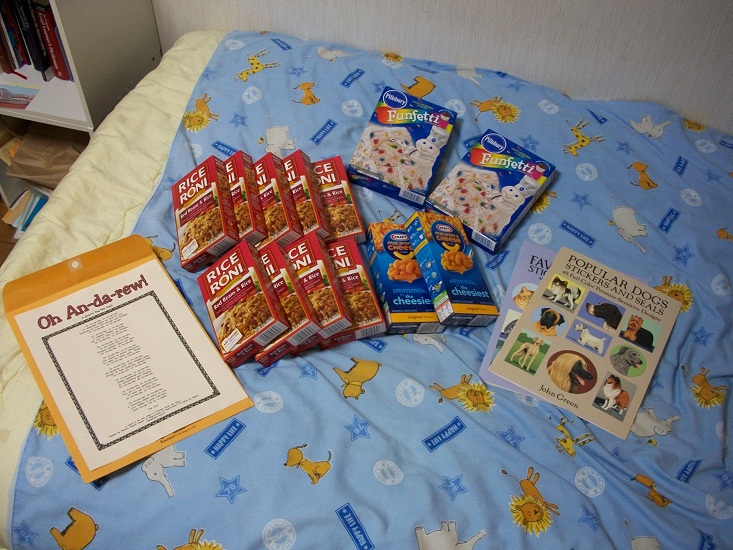
A big thanks to everyone who wished me a happy birthday! This past Friday I turned 23, which means that soon I will be considering retirement and an AARP membership. It also means that I got booty (the pirate kind, as my sister's card indicated), and in my excitement and gratitude I want to show off my new treasures:

My Grandma and parents got together and sent me boxes and boxes of rice-a-roni (!!!), stickers (for my students), and a poem composed by my father. I will include a sample of his masterpiece:

“Oh An-da-rew!”
(A poem in the epic meter of “Chicken Soup with Rice”)

Oh An-da-rew, oh An-da-rew
in Western Oregon he grew,
but now he lives on big Honshu,
Oh An-da-rew, oh An-da-rew.

Oh An-da-rew, oh An-da-rew
to old Kyoto fast he flew,
bringing stickers, pens and glue,
Oh An-da-rew, oh An-da-rew.


My coworkers got me cookies and a new bento box, which is more masculine and much larger than my last one (and you know what they say about a man who has a large bento box!). And finally, my most adorable gift- my supervisor's son made me some origami animals. I am the proud new owner of two dogs, a penguin, and a polar bear. Don't tell my landlord though, I'm not allowed to have pets! (Which reminds me- there's a second hand shop on my street that has a taxidermy-preserved polar bear in its window. I'm not even kidding. Tempted as I am to have a polar bear in my Japanese apartment, it literally would not fit in the stairwell.)


By coincidence my birthday happened to be on the same day as our office's welcome party for Libby and myself. This may seem a bit odd given that I started working in the office two months ago, but it was the best time for everyone and I'm certainly not going to complain! The party was held in the traditional enkai style, which meant that there was lots of traditional Japanese food and the “all you can drink” alcohol service. Alas, I do not drink, but I did take photographs of each course of the extended meal. They are included below with my commentary:


Eggplant, chirimenjako, and seasoned/grilled tofu. I have to admit that these are three things I would have never put in my mouth before I came to Japan. However, when I came over here I learned pretty quickly that no matter how gelatinous, raw, or tentacled an item was, if my hosts said it tasted good they were usually right. I managed to eat everything in this course, but the chirimenjako were a little difficult. They tasted a bit like jerky, but in reality they were hundreds of tiny marinaded and dried fish. Chirimenjako supposedly means “little fish,” so this is what we called them for the rest of the evening. Libby said she saw a little girl at the super market eating a sample of these things like candy- so I guess they aren't an acquired taste, even for Japanese children!


Raw salmon filet salad. This was the first time I'd ever had raw fish, at least in such an appreciable amount. It tasted good with all that dressing (like cooked salmon, but milder), but the texture took some getting used to.


Tofu Salad (with more little fish) and a sort of shrimp flavored croquette thing. People make some pretty awesome croquettes here in Japan, which is another reason I probably won't lose weight while I'm here.


Things start to get real. Actually, I'm not really sure what started to happen here. This was a little cup of savory jelly with something crispy in it. The taste was a little like miso soup, though much milder. Anyway, I wasn't able to finish this. We don't eat a lot of jelly-like things by themselves in America, and this was just a little too different. Nice, but difficult to swallow.


Whitefish and cheesy mashed root vegetable! One of the teachers traded me some of her fish for the rest of my previous course. I think I came out ahead in that deal. The fish was a little on the sweet side, which actually went very well with the mashed vegetable...maybe it was daikon, but I'm not sure.

...at about this time some champagne glasses were passed around and the lights went out. The next thing I knew, my supervisor came in carrying a Japanese-style birthday cake! For me! The chocolate wafer in the middle had my name written on it and everything! Note that I'm blushing so much in this picture that you can't tell I haven't been drinking.


The cake wasn't very big so it could only be cut into four pieces...with about 12 of us there besides the birthday boy, everyone else had to play Japanese-style rock-paper-scissors to decide who got the remaining pieces. ...although between high spirits, tipsiness, and some unsureness about which rules we were following, this took a while. In the end it was a moot point because all the winners shared their cake slices anyway. ^^;

But then it was time for the soup course! The colorful bit in the middle is a little fish cake modeled after a maple leaf.

I'll admit, I wasn't quite prepared for the steak and potatoes. Mike had been explaining the food to everyone else all evening (including some of the Japanese teachers), so when the steak came out I entreated him to tell us about the history of this particular Japanese dish. We concluded that it had originated in the Heian period, to the confusion of the Japanese staff- “But- but surely this is American?”

According to the teacher sitting next to me the next to the last course is always rice-based. This is because rice is supposed to be very filling, so the host wants to make sure everyone is full before they leave. This particular rice had some very expensive mushrooms in it, although I worry this was lost on me.

Dessert came last, although I neglected to take a picture of it. It was vanilla mousse and grape sorbet on top of pudding. I approved, although Japanese pudding is very different from American pudding. I'm still not sure how to describe it.

(Mike, I hope you don't regret giving me permission to post this photo of you!)

And suddenly we were looking around at each other over tables covered with empty dishes and beer bottles. The last course had been eaten, so all that was left to do was to take a group photo and totter out into the night unsteadily. Certainly, it was an evening never to be forgotten.

-Andrew

Saturday, October 15, 2011

Martha Stewart, Eat Your Heart Out.


Hello from Oregon...or is it Kyoto? It’s hard to tell today because it’s overcast with the occasional drizzle. The best part is watching the mist roll down the mountains surrounding Kyoto! I’ll admit to being a bit of a lump lately, with most of my time outside of work spent watching online television or working on my craft projects. In honor of my relative non-activity I dedicate today’s blog post to Crafts, Japanese Television, and the decorating of my apartment.


I promised to share pictures of my 1000 paper crane project once I got close to finishing, so here it is! 


 (Assembly!)

 (All done!)

Between the paper and the shiny thread I got the project cost around 1200 yen, or about $14 US dollars, give or take. Folding the cranes took about a minute each, and a string of cranes (50 per string) took about an hour to select the colors and then thread them together. If anyone out there feels like a good craft project, I highly recommend it. Folding cranes is a great way to keep your hands busy while watching TV...which brings me to my next topic-


Japanese Television!


It’s true that the Japanese have strange television. The discerning viewer can watch games of human tetris or enjoy watching a komodo dragon chase after pretty girls with steaks adhered to their heads. If you doubt the existence of the latter, I recommend you look it up on youtube.


Instead of throwing myself to the whims of the broadcasting networks, I’ve instead been using an online streaming site to watch Japanese dramas (“mysoju”). It’s a good way to practice listening to native Japanese speakers (which is a skill we don’t practice enough in schools) and pick up snippets of Japanese culture. I recommend this website, as it has a great library of dramas and most have English subtitles. If a video doesn’t load, you can always look up the next segment on google, sometimes with a faster stream.


Anyway- what are Japanese Dramas like? Most are between 8-12 1-hour episodes long, and (in my opinion) emphasize interpersonal relationships both inside and outside of the workplace. I’ve intentionally focused on comedy and romantic comedy, because the Japanese are less avoidant of unhappy endings as we Americans tend to be. In Japan even comedies tend to be very bittersweet in places. Here are some quick reviews of dramas I’ve seen and recommend:


Haken no Hinkaku (Temp. Worker’s Pride)
This drama follows a new department in a large food-stuffs company composed of an green-horn department head, a young untried salary employee, an elderly computer-illiterate employee, and a temporary employee who was considered nigh unhireable. The department would seem doomed to fail, except for the hire of a new “Super Temp” worker who is curt, mysterious, and above all competent at everything. It’s a little like Mary Poppins meets The Office, except it spends more time focusing on the issues that divide salary employees and temp workers in Japanese businesses. I give it a 9/10.


Dekichatta Kekkon (Shotgun Wedding, more literally “we made a baby wedding”)
This drama is about a young woman who finds herself pregnant after a one-night tryst. She decides to keep the baby, and proposes to broach the subject to her parents by staging a fake wedding engagement with the imminent baby’s father. Gradually the two begin to fall in love, with plenty of bumps in the road. I found the female protagonist cute at first, but as her behavior became more and more predictable I found the side characters to be more endearing. My favorite was the mother-in-law and the sister’s good-for-nothing boyfriend. I give the show a 6/10.


GiraGira (literally the sound of something dazzling)
In this drama a 35 year old professional finds himself laid off to cover up his boss’s mistakes. Thwarted at every turn to find a starting position job at a new company (he’s too old), he turns back to the job he had before he got married- as a host-bar host. While keeping the secret from his wife he saves the host-bar, stands up against the yakuza, and offers a more compassionate side to an entertainment profession often seen as scamming women of their money with compliments and alcohol. The men were a little too pretty for my taste, but the main character’s 5-year old daughter is super adorable and the female bar-owner is a fun tough-woman character. I give this show an 8/10.
 
As I mentioned before, I watch my Japanese television through sites that stream subtitled versions, but if I owned a television I would also be receiving the Japanese public broadcasting network called “NHK”. NHK stands for “Nippon Hoso Kyokai”, and while it is the PBS equivalent here in Japan it conducts its business a little differently. Instead of relying on memberships and donations, NHK collects a bimonthly fee of 2600 yen from anyone who uses their services. And thus the following conversation came to pass when the NHK man came to my door to collect money:


(The following conversation has been translated from Japanese to make Andrew appear better at the language than he actually is.)


NHK Man: Hello! I am from NHK, do you have a television?
Andrew: I do not. (Literally, "There is no television.")
NHK Man: Do you have a personal computer?
Andrew: Yes, but it is not hooked up to receive television.
NHK Man: Do you have a cell phone? What cell phone company do you use?
Andrew: (perplexed) Uh, yeah. I don’t know which company, I’ll show it to you.


The fellow from NHK fiddled around with my cell phone for about a minute and then gave it back to me. On the screen was a tiny box displaying a television program with poor sound quality and the tendency to become jerky from moment to moment.


NHK Man: (Triumphant) You can watch television on your phone, so that will be 2600 yen! (approx. $30).
Andrew: Bwah? (The meaning of this word is universal, so I have not translated it.)


Keep in mind that I use the free cellphone that came with my incredibly basic plan and hadn’t even been aware that my cell phone had a television. I felt tricked, but lacked the Japanese to articulate this, so I figured I would pay the money to get the man out of my apartment and then show the official documentation to my boss.


Upon further research it turns out that anyone who owns a device capable of receiving NHK’s services –must- pay the fees, according to a law drafted in the 1950's. But, as many other foreigners and Japanese have realized, the law was put into affect with the assumption that everyone would follow it, and lacks any stipulations for enforcement. NHK cannot force a citizen to pay, and after some corruption scandals within the network became public, many Japanese began to refuse to do so.


My advice to future JETs/ALTs is not to let anyone bully you into paying for a service that you aren’t using. At the very least refuse to pay until they’ve brought an English representative to your door, so you know exactly what they’re asking for and why. While I do think that you should pay if you are using a television/watching their networks, people shouldn’t have to pay a television bill for their cell phone. Next time I’ll have Alistair drive the NHK man from my apartment.

Finally, in brief, I have been decorating my apartment after the realization about a month ago that it didn't feel quite like home yet. Here's what I've done with the place:


New curtains! The old ones were off-white, and there was also a pink and purple butterfly sheet put over the smaller window. I think the new plant motif is much better.


I also got some houseplants and on a whim, a little ceramic hedgehog to keep them company.


Finally, I bought a large area carpet and a “floor chair” to sit on. Have you noticed it all matches?

That's all for now. I'll be writing again soon, to make up for my blog-silence last week.

-Andrew

Wednesday, October 5, 2011

Holy Junk-mail!

Since I last updated my blog, my stay in Japan has hit its two month mark. As a young man with a BA in Psychology I've been watching myself carefully for interesting developments, but thus far I have failed to go raving mad...which I will put down as a promising sign.

Before I continue on to the meat of today's entry, I have an announcement of sorts to make. I'm fond of repetitious crafts and recently set my sights on making 1,000 paper cranes. According to Japanese tradition, a person can fold 1,000 paper cranes in order to wish for something very important. The most famous example is a little girl by the name of Sadako Sasaki who was diagnosed with leukemia at the age of 11 after being exposed to the Hiroshima atom bomb radiation at age 2. Sadako had wished to survive her leukemia, and began folding the cranes to make this hope a reality. Unfortunately there was very little paper in the hospital, and Sadako only completed 644 cranes before she succumbed to her illness at the age of 12. Her friends completed her project and buried her with the strings of paper cranes.

Today paper cranes are offered at the memorial of the Hiroshima bombing in memory of the children who died, and also as a hope for world peace. The preexisting traditions of the paper crane also live on, with newly weds and new born babies receiving 1,000 paper cranes to wish them one thousand years of happiness. Mercifully I am not terribly ill, nor am I expecting an impending marriage or pregnancy, but I thought it would be a fun gesture to fold a set of paper cranes and wish for a good year here in Japan. As of a few days ago I hit my 500 crane mark, and thought I would show everyone my progress so far:


(this is what 548 cranes looks like)


(and here's one in my hand for a size comparison)

Presently I'm up to 700 cranes, and still going strong. I'll update you when I start stringing them together!

And now from the sublime to the ridiculous- as promised here's a sampling of the junk mail I've received since I arrived here in Japan.


The 7-11 near my apartment recently had a remodel, so they sent out this ad for their grand reopening. 7-11 is one of the big convenience store chains here in Japan, it's a bit surreal that there's a 7-11 near my home both here in Japan and in Oregon.


I haven't tried reading the Japanese on this pamphlet, but I'm guessing that this fellow is a Japanese politician running for office. The “Kyoto Party” business in the top right corner seems to affirm this, unless it's asking me to go party with this good looking fellow somewhere in Kyoto. He's also got the stock politician photo near the bottom of him raising his hand while undoubtedly explaining something intelligent and reasonable to the cabinet. 


(“I motion that we all go out to give speeches on street corners and enrapture middle-aged women by holding their hands.”)


KFC is big in Japan, and they deliver! Alongside the Colonel there is always a logo of a delivery man on a scooter rushing to inflict heart attack on the unsuspecting Japanese public.


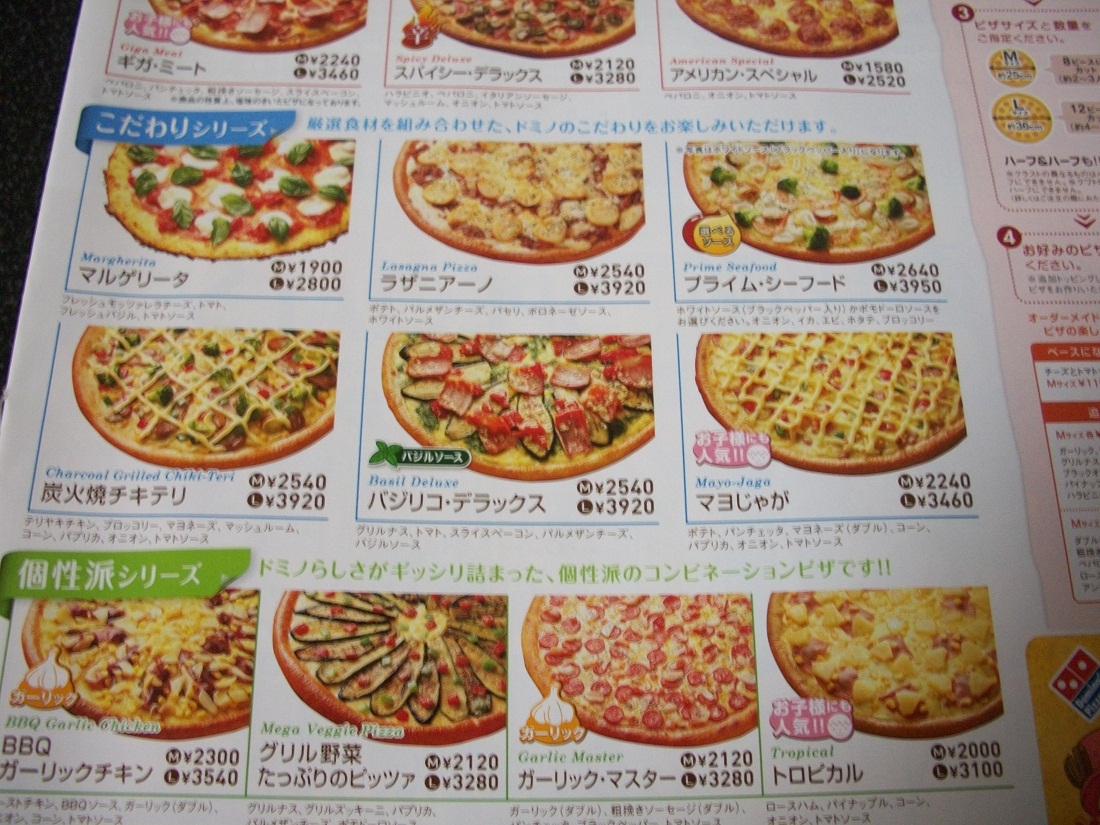
By far I get the most Pizza ads in my mailbox. It's like they know I'm young, male, and single. Fortunately for my waistline, pizza here in Japan is really expensive. If you look at the prices you'll notice that a large pizza can go for 3500-3900 yen. That's a $40 pizza. Also, please note the seafood pizza and the “Mayo-Jyaga” pizza.


Apparently you can also get sushi delivered, or at least that's the sense I get from the piles of sushi ads that like to vie with the pizza ads for “most likely to be seen in Andrew's mailbox”. They usually also come with hefty coupons, which is good because even after a 1000 yen discount a party platter of sushi is still around 55 dollars.


Once you've eaten all that KFC, Pizza, and Sushi, you can find yourself inspired by “Brain World News” to improve your stress levels and your waistline. I suspect that this is actually a front for mind-controlling aliens who are using this as a thinly veiled pretext for abducting people and taking them back to this “Brain World” of theirs. Undoubtedly these hapless victims then spend the rest of their lives wearing brightly colored spandex, running through mazes, and posing for exercise ads.


I got this the first week that I was here, and honestly didn't know what to make of it. Christianity isn't very big here in Japan (although there is a Catholic church just down the road), and I have to wonder if this artist's rendition of Jesus will make it appeal...I have a difficult time with the artists who capitalize on Christ's suffering (rather than his dignity) by making him look like a kicked spaniel.

That's all for now! If you'd like to send me paper mail to thin out the junk and bills just contact me by email or facebook, or let my parents know! We'll hook you up with my address.

-Andrew